
Many parents wonder what the best age for their child is to start learning to code. Some have concerns over too much screen time, while others don't want to miss the opportunity to learn during their child's peak brain plasticity (its ability to change and adapt). So today we'll take a look at some factors to help you make the right decision for your child.
The Best Age for Children to Start Coding
Research has shown that the brain is more receptive to learning during childhood and adolescence, and that the brain's plasticity is greatest during this time. This may make it easier for younger learners to learn new skills, including coding.
However experts now also believe that under the correct circumstances, practicing a new skill can change hundreds of millions, if not billions, of connections between nerve cells in the brain even into adulthood. So it's never too late!
In general, the earlier, the better to learn programming - similarly to the advice recommended for learning another speaking language. Here's why:
- Children may be more receptive to learning new things and may find it easier to pick up new concepts.
- Children will learn valuable skills including problem solving and creativity.
- Early exposure to coding can help foster an interest in technology and computer science, which can lead to a fulfilling career path.
- Coding skills are becoming increasingly valuable in today's digital age, and learning to code at a young age can help prepare kids for general digital literacy.
However, it's important to note that age is not the only factor that affects a child's ability to learn to code. Factors such as prior knowledge, motivation, and access to resources can also play a role in how easily someone is able to learn to code. Ultimately, the most important consideration is your child's dedication and determination to learn and improve their skills. You want them to be excited and not feel forced to learn!
The Best Age for Your Child to Start Learn to Coding: Loose Guidelines
Here are some considerations for when to begin kids coding. It is important to keep in mind that every child is different and may be ready to learn different things at different ages. The key is to individualize your student's learning experience to meet their needs, abilities, and interests. You can see in the figure below idea of ages and languages to possibly learn.
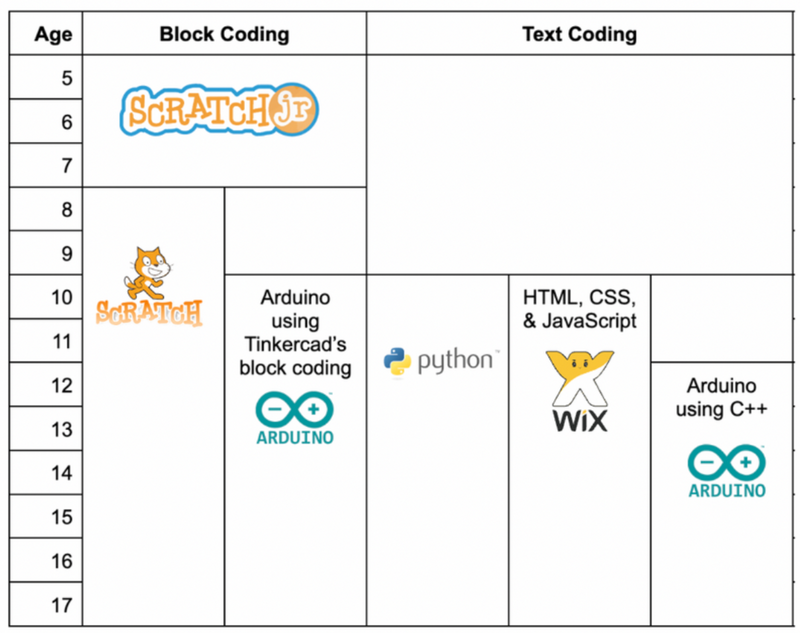
Starting at age five: By about the age of five, children typically develop the cognitive foundation and motor skills to begin interacting with introductory logic-based toys and apps. While they cannot yet understand the syntax of text-based languages, they can easily master core concepts like sequence and cause-and-effect. Using free, icon-based tools like ScratchJr, kids learn to give simple visual commands to make characters move and speak. To help them take their first guided steps, check out Create & Learn's live online, small-group Scratch Junior class, where expert teachers make early coding engaging and fun.
Age 5 Coding Milestones:
- Key Skills: Visual pattern recognition, cause-and-effect logic, and basic motor skills
- Ideal Interface: Icon-based drag-and-drop interfaces (no reading required)
- Top Tool: ScratchJr
Starting at age eight: By around age eight, students transition to intermediate entry-level coding concepts using robust block-coding tools like Scratch and Thunkable. At this stage, children are cognitively ready to understand structural logic such as loops, variables, and conditional statements. They also begin to develop the problem-solving and critical-thinking skills required to debug and test their work, allowing them to troubleshoot simple errors in their code. To help them build a strong foundation, sign up for Create & Learn's live, expert-led Scratch Ninja class, where they will design games and interactive projects in a structured, small-group environment.
Age 8 Coding Milestones:
- Key Skills: Logical problem-solving, structural design, loops, variables, and basic data types
- Ideal Interface: Reading-based block programming
- Top Tools: Scratch and Thunkable
Starting at age ten: At around age ten, students reach a key milestone: their typing proficiency and abstract thinking are typically advanced enough to learn text-based languages. Children at this stage can grasp complex concepts like functions, lists/arrays, and object-oriented programming. It is the perfect age to introduce professional languages like Python or explore web development by writing HTML, CSS, and JavaScript. To launch their journey into text-based code, explore our small-group Python for AI class, or learn to design custom websites in our hands-on Web Design class.
Age 10+ Coding Milestones:
- Key Skills: Keyboard typing proficiency, structured functions, arrays, object-oriented basics, and text-based syntax
- Ideal Interface: Text-based programming languages and web editors
- Top Tools: Python, HTML/CSS, and JavaScript
What age is too young to start to learn to code?
While we recommend kids not begin coding until age 5, it doesn't mean your child can't start tinkering with technology before then. Your child might start playing with your phone at 3 years old, and maybe even become a YouTube-watching expert or mobile app playing wiz at age 4. There's many educational games and activities for younger kids.
The Best Age for Your Child to Start Learning Specific Programming Languages
Let's take a look at when experts say it's best to begin learning programming languages. Learn more about Python vs Scratch here.
What age is best to start Scratch coding?
MIT Media Lab experts designed Scratch to be used by children ages 8-16. Scratch provides a number of fun getting started ideas on its website. To learn from an award-winning comprehensive curriculum and get answers to questions, join a live online class for kids led by an expert:
What age is best to start Python coding?
Python programming is best to begin around age ten to eleven. If you've never programmed before, the tutorials here on Python are recommended for you; they don't assume that you have previous experience. Check out the section of resources for young learners.
Your student can also join an engaging live online class led by an expert, designed by professionals from Google, Stanford, and MIT:
Decide the best age for your child to begin learning coding
Once you've picked an age for your child to begin, it's time to find the best ways to help them learn. Up next, learn more about teaching kids to write code.