If you’re looking into science competitions or research for middle or high school students, you’ve likely heard of the "Junior Nobel Prize." That’s the nickname for the Regeneron Science Talent Search (STS), the gold standard of science/STEM competitions for high school students. This prestigious program is part of a powerful science research pipeline managed by the Society for Science. For middle school students, the journey often begins with the Thermo Fisher Scientific Junior Innovators Challenge, the nation's premier middle school STEM competition. From there, many students move on to the Regeneron International Science and Engineering Fair (ISEF), the world’s largest high school science competition. While ISEF focuses on a massive global field of 9th–12th graders, Regeneron STS is the final, elite peak for high school seniors, focusing on the long-term potential of the student as a future leader in science.
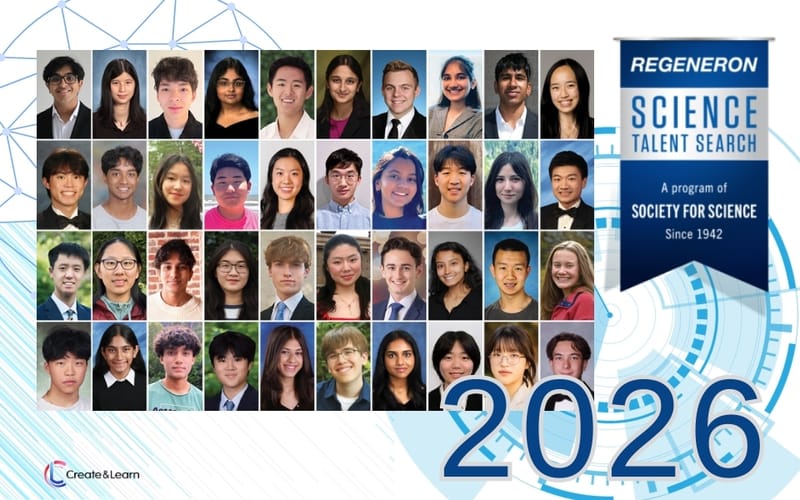
The results for Regeneron STS 2026 are in, with record breaking participations and research projects that are more impressive than ever. From over 2,600 entrants, the 40 finalists were chosen for their scientific rigor and potential to change the world. While the topics are very diverse from math, biology, to physics and robotics, there's a secret weapon appearing in almost every winning project: coding for high school students has become an essential tool for modern discovery. Among them, Python is the core programming skills. Start with a free trial class to start learning Python today.
We will take a deep dive into these research projects—examining the computational tools students used and how to learn the essential programming skills behind them. Although this analysis focuses on the top 40 Regeneron STS projects, the broader trends apply to most STEM competitions for middle and high school students.
A Map of Innovation: The 9 Primary Research Domains by the 40 Regenron STS Finalists
In the 2026 Regeneron STS, the most successful research for high school students demonstrated that the best way to win science/STEM competitions is to master a specific domain while being fluent with interdisciplinary tools, especially computer science/coding skills
Based on an analysis of the 40 individual finalist profiles from the 2026 Regeneron STS, here is the breakdown of projects by domain. Because many projects are interdisciplinary (e.g., using AI to solve a biology problem), they have been counted in every category that applies to their research methodology and subject matter.
Project Count by Category
A key observation is that about 50% of the projects involve computer science, especially AI & Data Science, as they are the essential tools used in delivering insights from domain specific research.
For example, Edward Kang’s RetinaMind uses AI to detect neuro-developmental disorders through eye images, and Leon Wang’s work uses machine learning to repurpose existing drugs to fight Alzheimer’s. Even art and safety have gone digital, with Ella Lu using computer vision to analyze Impressionist masterpieces and Jonathan Yan developing AI-powered tools for cyclist safety.
AI & Data Science - The Top Coding Skills for Middle School & High School Science Research
Based on an analysis of the project descriptions, research posters, and methodologies of the 2026 Regeneron STS finalists, the computational tools are heavily weighted toward Python-based AI and Bioinformatics.
Below is a breakdown of the tools most frequently mentioned or utilized across the projects:
1. Programming & Core Data Science
- Python: The undisputed leader. Used for everything from Connor Hill’s geometry simulations to Leon Wang’s deepfake detection.
- R: Frequently used in the Medicine & Health category for statistical analysis and clinical data visualization.
- MATLAB: Preferred by students in Physics and Engineering for signal processing and complex mathematical modeling.
- C++ / Java: Used in high-performance computing scenarios or competitive programming-style algorithms.
2. Artificial Intelligence & Machine Learning
- PyTorch / TensorFlow: The primary frameworks for building and training neural networks.
- Scikit-learn: Used for "traditional" machine learning (regression, random forests, clustering) in nearly all data-heavy projects.
- CNNs & RNNs: Specific architectures (Convolutional/Recurrent Neural Networks) were common for projects analyzing images or audio.
- Large Language Models (LLMs): Several projects utilized or analyzed transformer architectures for NLP or code-related research.
3. Bioinformatics & Life Sciences Tools
- AlphaFold / RoseTTAFold: Used for protein structure prediction, especially in drug discovery projects.
- BLAST: For DNA and protein sequence alignment.
- GROMACS / AMBER: Used for molecular dynamics simulations to see how drugs interact with proteins.
- ImageJ / Fiji: The standard for analyzing biological images and microscopy data.
4. Specialized Modeling & Engineering Tools
- SolidWorks / Autodesk Fusion 360: Used for CAD (Computer-Aided Design) in engineering projects like Leanne Fan's microgravity simulator.
- Mathematica: Heavily used by the Math finalists for symbolic computation and visualizing complex geometries.
- Latex: While not a "calculation" tool, it is the standard for formatting the highly technical research papers submitted by all finalists.
5. Hardware & Robotics Toolkits
- Arduino / Raspberry Pi: Used as the "brains" for physical prototypes and sensors.
- ROS (Robot Operating System): Mentioned in projects involving autonomous movement or robotic arms.
- OpenCV: The go-to library for projects involving computer vision and real-time object tracking.
Summary Table: Computational Tools by Category and Learning Path
This table summarizes the research categories to the specific computational tools and the corresponding coding classes for kids & teens to help students master them.
Top Coding Classes for Research and Science Competitions
We offer a wide variety of classes for students in grades K-12. The following, which are also referenced in the table above, will help students start mastering key computer science skills that are essential for research and STEM competitions like the Regeneron STS, ISEF, and Thermo Fisher Scientific Junior Innovators Challenge. These classes are accessible for most middle and high school students.
Python for AI (Grades 5-12) This foundational course introduces students to Python, the most popular programming language in the industry and the primary programming language used by nearly all Regeneron STS finalists. Students move beyond basic syntax to master essential concepts like variables, loops, and functions, which are the building blocks for creating scientific simulations and automating data collection. By the end of the course, students have the coding literacy required to dig more info Data Science and Artificial Intelligence use cases using Python programming.
Data Science with Python and Pandas (Grades 6-12) In this course, students learn how to turn raw information into scientific insights using the same tools professional researchers use. The curriculum covers the entire data lifecycle—from cleaning messy datasets to performing advanced statistical analysis and creating compelling visualizations. This is a critical skill for any STEM research and competition, as it teaches students how to use evidence to back up their research hypotheses and present their findings clearly to judges.
AI Creators (Grades 6-12) Designed for students ready to dive into the world of Machine Learning, this course teaches students how to build and train AI models using AI frameworks and APIs. Students learn the mechanics of neural networks, computer vision, and natural language processing, allowing them to create projects similar to the top STS finalists who use AI for medical diagnostics or environmental monitoring. It provides a deep dive into the "black box" of AI, giving students the power to innovate rather than just use existing tools.
Advanced Python with AI Vibe Coding (Grades 7-12) This course is tailored for students who have mastered the basics and want to build complex, high-performance applications. It covers advanced data structures, object-oriented programming, and complex algorithm design. More importantly, students learn how to write efficient, scalable code with the assistance of AI that can deliver highly complex projects much more quickly.
Computational Biology (Grades 7-12) As one of the fastest-growing fields in science, this course teaches students how to apply computer science to solve biological mysteries. Students explore how to analyze DNA sequences, model protein structures (like AlphaFold), and use data to understand disease. This course is a perfect fit for students aiming for the "Medicine & Health" or "Biology" categories of the STS, as it bridges the gap between the laboratory and the computer screen.
Robotics & Smart Devices with Arduino (Grades 4-9) This course introduces the "hardware" side of research, teaching students how to use Arduino microcontrollers to build physical sensors and robotic systems. Students learn how to write code that interacts with the physical world, which is essential for engineering projects like building microgravity simulators or autonomous environmental monitors. It is the perfect starting point for students who want their research to involve tangible inventions and hardware prototypes.
C++ Programming (Grades 6-12) Known for its speed and efficiency, C++ is the language of choice for high-performance engineering and complex robotics. This course teaches students the fundamentals of C++ programming. For students entering STEM competitions with projects involving real-time processing, autonomous vehicles, or advanced physics simulations, mastering C++ provides a massive competitive advantage in technical execution.
2026 Regeneron STS Project Showcase Summary
Check out the full list of all 40 finalists, sorted alphabetically by last name. These students have set the bar for science/STEM competitions worldwide:
Start Your Own Journey on Science Research Today
Research is so much more than just exploring the frontiers of science; it is a powerful invitation for students to roll up their sleeves and tackle the real-world problems they are truly passionate about. These 40 finalists have demonstrated success with deep knowledge, bold creativity, and relentless grit. But here is the most exciting part: you can do it too! By diving into topics that spark your curiosity and mastering the coding and computational tools essential for modern discovery, you can solve the same kind of impactful real world problems and the next great breakthrough might just be yours!
Want to meet the finalists yourself? You can explore their full research posters and watch their video presentations at the Society for Science 2026 Project Showcase. Go get inspired!