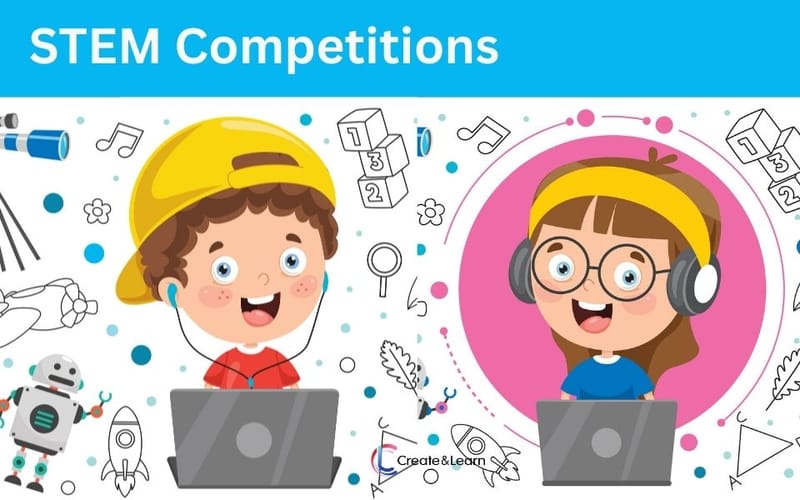
STEM/Science competitions and challenges are great ways for middle school students to explore different science topics outside of the class, apply what they have learned to solve real world problems, and have fun! Coding skills are essential to help them create competitive entries— building apps, robotics, AI, more. Some competitions are coding focused, e.g. Congressional App Challenge, while many use coding to analyze data, do research, or create websites to showcase their results. Python, Robotics, and Artificial Intelligence, are popular for science fairs. Start learning today with our award-winning free coding classes for kids and live online STEM camps. We also host private tutoring classes for science competitions if you need help. Simply email us at support@createandlearn.us to request more information.
Let’s take a look at some top Science Competitions for middle schoolers. Students are also invited to join Create & Learn's annual Code for Nature Challenge to protect nature and help those affected by environmental change - and a chance to win Amazon gift cards and more.
- Why Join Science Competitions in Middle School?
- Best Science Competitions for Middle School Students
- Browse Middle School Science Competition By Categories
- Coding Classes for Supporting Science Competitions And Challenges for Middle School Students
Why Join Science Competitions (STEM Competitions) in Middle School?
STEM competitions provide exciting opportunities for middle schoolers to explore, learn and have fun! Here are some key reasons to give Science Competitions a try.
- Explore interests beyond the classroom - Middle school competitions allow students to discover new subjects and areas of interest that go beyond regular school coursework.
- Develop problem-solving and critical thinking skills - Students learn how to analyze challenges, think creatively, and apply knowledge to real-world problems.
- Build teamwork and leadership skills As a great after-school activity, competitions teach students how to work effectively in teams, communicate ideas, and take on leadership roles.
- Prepare for high school science competitions Participating in middle school competitions helps students practice research, presentation, and competition formats, building confidence and readiness for high school-level STEM competitions.
Last, but not least. Have fun!
Best Science Competitions for Middle School Students
Here are the top 18 STEM competitions to consider for 2026. The list is roughly ordered by time. Note that many competitions have multiple rounds and competition dates, and dates may also vary by location. Check the website for details.
WINTER 2026 (January – March) Science Competitions
1. Thermo Fisher Scientific Junior Innovators Challenge (JIC)
The Thermo Fisher JIC is the nation’s premier STEM research competition for middle school students. Unlike high school fairs where you can apply directly, students must qualify by placing in the top 10% of a Society for Science-affiliated local or regional science fair. Nominees then submit an online application to compete for national recognition. The competition invites the top 30 finalists to Washington, D.C., to showcase their projects, compete in team challenges, and vie for over $100,000 in awards. It is the middle school pathway that prepares students for the high school ISEF.
- Subject: General Science / Research
- Grade Level: 6–8
- Typical Due Date: Local fairs held Jan–March. National application due in June.
- Format: Individual or Team (at local level)
- Region: United States
- Organizer: Society for Science
- URL: societyforscience.org/jic
2. USA Computing Olympiad (USACO)
The most prestigious algorithmic programming competition for pre-college students in the US. While dominated by high schoolers, it is open to middle school students, and starting early is a massive advantage. It consists of four online contests (Bronze, Silver, Gold, Platinum). Top performers are invited to a summer training camp to select the US team for the International Olympiad in Informatics (IOI).
- Subject: Computer Science / Algorithms
- Grade Level: K–12 (Advanced Middle School students typically start in Bronze)
- Typical Due Date: Contests held Dec, Jan, Feb, and March. For 2026: Contests are Jan 9–12, Jan 30–Feb 2, and Feb 20–23, 2026.
- Format: Individual (Online)
- Region: United States (International participation allowed)
- Organizer: USA Computing Olympiad
- URL: usaco.org
4. Girls Who Code Challenge
Held annually, the Girls Who Code Challenge encourages students to use coding and technology to solve real-world problems that impact their communities. Participants work individually or in teams to design creative, socially meaningful tech solutions. The theme for this year is AI + Cybersecurity.
- Subject: Computer Science / Coding
- Grade Level: Ages 13–18 (Appropriate for 7th/8th graders)
- Typical Due Date: Submission Deadline in Feb. For 2026: Submission deadline is Feb 11, 2026.
- Format: Individual or Team
- Region: United States
- Organizer: Girls Who Code
- URL: girlswhocode.com
5. Discovery Education 3M Young Scientist Challenge
Students create a 1-2 minute video explaining a unique solution to an everyday problem. Finalists work one-on-one with a 3M Scientist Mentor.
- Subject: General Science / Innovation
- Grade Level: 5–8
- Typical Due Date: Submission Deadline in April
- For 2026: Entries open through April 30, 2026.
- Format: Individual
- Region: United States
- Organizer: 3M and Discovery Education
- URL: youngscientistlab.com
- Recommended Class: Scratch Coding (Great for creating animated diagrams for the submission video).
6. America's Youth AI Festival @ MIT
This special national event celebrates the United States' 250th anniversary by showcasing students' visions for the future of Artificial Intelligence. Hosted by MIT RAISE and Day of AI, the festival invites students to submit AI-powered STEM solutions for health, climate, and more, as well as art, and civic projects. Winners earn an all-expenses-paid trip to Boston to present their work at MIT.
- Subject: Artificial Intelligence / Innovation / Civics / Arts
- Grade Level: K–12
- Typical Due Date: Submissions due March 2026. For 2026: Submission portal opens Feb 17, 2026; Deadline is March 13, 2026.
- Format: Individual or Team
- Region: United States
- Organizer: Day of AI and MIT RAISE
- URL: dayofaiusa.org/festival
7. Wix Tomorrow "Creators of Tomorrow" Challenge
An international web design challenge where students build websites that tackle social issues (specifically the UN Sustainable Development Goals). Students use the Wix platform to create professional-quality sites to drive change.
- Subject: Web Design / Social Impact
- Grade Level: Ages 13–18
- Typical Due Date: Submission Deadline in March. For 2026: Submission deadline is March 8, 2026.
- Format: Individual or Team
- Region: International
- Organizer: Wix
- URL: wix.com/tomorrow/creators
SPRING 2026 (April – June) Science Challenges/Competitions
8. Genes in Space
Students propose a DNA experiment that addresses a challenge of space exploration. The winning experiment is actually performed by astronauts aboard the International Space Station. No lab equipment is needed to apply.
- Subject: Biology / Genetics
- Grade Level: 7–12
- Typical Due Date: Submission Deadline in April. For 2026: Submission deadline is April 10, 2026.
- Format: Individual or Pair
- Region: United States
- Organizer: miniPCR bio & Boeing
- URL: genesinspace.org
9. Science Olympiad (Division B)
While Envirothon is primarily high school, Science Olympiad is the leading team science competition for middle schoolers (Division B). Teams compete in 23 events ranging from "Disease Detectives" and "Dynamic Planet" to engineering builds like "Tower" or "Wheeled Vehicle." It covers biology, chemistry, earth science, and physics in a fun, tournament-style format.
- Subject: General Science / Engineering
- Grade Level: 6–9 (Division B)
- Typical Due Date: Regional tournaments run Feb–March; State in April.
- Format: Team (15 students)
- Region: United States
- Organizer: Science Olympiad, Inc.
- URL: soinc.org
10. ArcGIS Online School Competition
Students research a topic within their home state (often solving a local problem) and present their results using Esri's ArcGIS StoryMaps software. This blends geography, data analysis, and digital storytelling. There is a specific competition track for middle school students (grades 4–8).
- Subject: Geography / Data Science
- Grade Level: 4–8 (Middle School Division)
- Typical Due Date: State deadlines vary (April/May).
- Format: Individual or Team (2 students)
- Region: United States
- Organizer: Esri
- URL: arcgis.com
FALL 2026 (September – December) Science Contests/Competitions
11. AFA CyberPatriot (Middle School Division)
AFA CyberPatriot, the National Youth Cyber Defense Competition, inspires students toward careers in cybersecurity. There is a dedicated Middle School Division where teams are challenged to secure computer systems (virtual images) by finding and fixing vulnerabilities. It is beginner-friendly and distinct from the high school competition.
- Subject: Cybersecurity
- Grade Level: 6–8
- Typical Due Date: Teams register in Aug - Sept and start practicing. Nationals are typically held in March the following year.
- Format: Team (2–6 students)
- Region: International
- Organizer: Air & Space Forces Association (AFA)
- URL: uscyberpatriot.org
12. STEM Racing (F1 in Schools)
Teams design a better, faster, and cooler miniature F1 car using CAD/CAM software to be manufactured and raced. The competition emphasizes engineering, project management, branding, and marketing. There are entry-level classes suitable for younger students.
- Subject: Engineering / Design
- Grade Level: Ages 9–19
- Typical Due Date: Teams should be formed by late September/early October.
- Format: Team (3–6 students)
- Region: International
- Organizer: F1 in Schools Ltd
- URL: stemracing.com
13. StellarXplorers Aerospace STEM Program
Teams tackle a space design challenge involving orbit determination, satellite component selection, and launch vehicle planning. It features a series of online qualifying rounds leading to an in-person National Finals.
- Subject: Aerospace Engineering
- Grade Level: 6–12
- Typical Due Date: Teams should be formed by late September/early October.
- Format: Team (2–6 students)
- Region: United States
- Organizer: Air & Space Forces Association (AFA)
- URL: stellarxplorers.org
14. FIRST® LEGO® League (FLL) Challenge
(Replaces FIRST Robotics Competition) FLL is the premier robotics competition for middle schoolers. Unlike the high school FRC which uses large metal robots, FLL teams build and program autonomous robots using LEGO Spike Prime or Mindstorms technology to score points on a themed playing field. Teams also conduct an "Innovation Project" to solve a real-world problem. It emphasizes "Core Values" like discovery and teamwork.
- Subject: Robotics / Engineering
- Grade Level: 4–8
- Typical Due Date: Teams form in Aug/Sept. Regional tournaments happen Nov–Jan.
- Format: Team (up to 10 students)
- Region: International
- Organizer: FIRST
- URL: firstinspires.org/robotics/fll
15. Congressional App Challenge
The Congressional App Challenge is a nationwide STEM competition that invites middle and high school students to design and build their own original apps. Sponsored by members of the U.S. Congress, this challenge encourages students to use technology to improve their community. Winners are selected at the congressional district level.
- Subject: Computer Science / Coding
- Grade Level: 6–12
- Typical Due Date: Submission Deadline in Oct. For 2026: Deadline is typically late Oct 2026.
- Format: Individual or Team (up to 4)
- Region: United States
- Organizer: Internet Education Foundation, US Congress
- URL: congressionalappchallenge.us
16. National Science Bowl (NSB)
Teams face off in a fast-paced, question-and-answer format similar to a TV quiz show. Students answer questions on a range of science disciplines including biology, chemistry, Earth and space science, physics, energy, and math. The Middle School division is separate from High School.
- Subject: General Science
- Grade Level: 6–8
- Typical Due Date: Registration deadline is October/November. Finals in April/May.
- Format: Team (4–5 students)
- Region: United States
- Organizer: U.S. Department of Energy
- URL: science.osti.gov/wdts/nsb
17. NASA Dream with Us Engineering Challenge
The NASA Dream with Us Challenge invites students to imagine and design innovative aviation solutions for real-world problems and show NASA their vision for the future of flight. Teams work together to solve a specific challenge, such as using new aviation technology to improve industries like agriculture.
- Subject: Aeronautics / Engineering
- Grade Level: 6–12
- Typical Due Date: Registration deadline Nov/Dec.
- Format: Team
- Region: United States
- Organizer: NASA Aeronautics
- URL: nasa.gov/dream-with-us
18. AMC 8 (American Mathematics Competitions)
The AMC 8 is the most prestigious middle school math competition in the United States. It challenges students with problem-solving questions that develop analytical thinking and logic. High-scoring students on the AMC 8 are often recruited for advanced math circles and prepared for the high school AMC 10/12 and AIME series. It is the primary entry point for the "Olympiad" math path.
- Subject: Mathematics
- Grade Level: 8 and below
- Typical Due Date: Registration by Nov/December. The exam is typically in mid-January.
- Format: Individual (25 questions, 40 minutes)
- Region: International
- Organizer: Mathematical Association of America (MAA)
- URL: maa.org/math-competitions
Middle School Science Competition Categories
Here are the middle school science competitions from the list above, categorized by subject.
General Science Competitions
Includes biology, chemistry, physics, environmental science, aerospace, and research.
- Thermo Fisher Scientific Junior Innovators Challenge (JIC): The premier research competition for middle schoolers (requires nomination from a local fair).
- National Science Bowl (NSB): A buzzer-style quiz competition covering biology, chemistry, earth science, physics, and energy.
- Science Olympiad (Div B): Teams compete in 23 events covering all science disciplines, including lab work and building devices.
- Genes in Space: Focuses on biology and genetics experimentation in a microgravity environment.
- NASA Dream with Us: Aeronautics and engineering design challenges.
- StellarXplorers: Aerospace engineering involving satellite and orbit planning.
- STEM Racing (F1 in Schools): Applied physics and aerodynamics through designing miniature cars.
- ArcGIS Online School Competition: Geography and environmental analysis using digital mapping tools.
Computer Science (CS) & AI Related Competitions
Includes coding, algorithms, cybersecurity, web design, and data science.
- USA Computing Olympiad (USACO): Algorithmic programming contests (C++, Java, Python).
- Congressional App Challenge: Mobile app development for solving community problems.
- Girls Who Code Challenge: Coding solutions for real-world issues (AI + Cybersecurity theme).
- AFA CyberPatriot (Middle School Div): Cybersecurity defense and operating system hardening.
- America's Youth AI Festival: Innovation in Artificial Intelligence, including ethical and civic applications.
- Wix Tomorrow: Web design and development.
- FIRST® LEGO® League (FLL): Involves significant block-based or text-based programming of autonomous robots.
- ArcGIS Online School Competition: Involves data science and geospatial analysis technologies.
Robotics & Engineering Competitions
Includes mechanical design, electronics, and hardware building.
- FIRST® LEGO® League (FLL): The standard middle school robotics competition; teams build and code robots to complete missions.
- Science Olympiad (Div B): Always features engineering/robotics events (e.g., Robot Tour, Tower, Wheeled Vehicle).
- STEM Racing (F1 in Schools): CAD/CAM design and manufacturing of miniature racing cars.
- NASA Dream with Us: Engineering design challenges for future aviation.
Mathematics Competitions
Includes theoretical math, applied math, and logical reasoning.
- AMC 8: The leading problem-solving math exam for students grade 8 and below.
- MATHCOUNTS: A high-intensity "bee-style" math competition with individual and team rounds.
- National Science Bowl (NSB): Includes specific rapid-fire mathematics questions.
- StellarXplorers: Requires calculation of orbital mechanics and system parameters.
Coding Classes for Supporting Science Competitions And Challenges for Middle School Students
Coding skills play an increasingly important role in science competitions and STEM challenges starting from middle school for AI, data analysis, apps, robotics, and research projects. These Create & Learn classes are especially relevant for competition preparation:
- Python for AI A foundational coding class for all students, widely used in AI, research, and science fair projects.
- Mobile Coding with Thunkable Learn to design and build mobile apps, ideal for challenges like the Congressional App Challenge.
- Arduino Programming for Robotics Learn to program microcontrollers, work with sensors, and build hardware-based projects for robotics and engineering competitions.
- Wix Website Design Build professional websites, especially useful for the Wix Tomorrow Challenge and project showcases.
- AI Creators Explore practical AI tools and applications commonly used in science fairs, research, and robotics competitions.
- Data Science with Pandas Learn how to analyze and visualize data—an essential skill for research-based competitions.
- Advanced Python & AI-Assisted Coding Build advanced projects more efficiently using modern Python techniques and AI tools.
Tips for Science Competitions / Contests for Middle Schoolers- How to Get Ready
Preparing for science competitions in middle school is a great way to build skills, confidence, and curiosity. These tips can help students get the most out of the experience:
- Start early and build strong foundations Begin by studying background materials and learning the basic concepts related to the competition. Early preparation helps students feel more confident and reduces last-minute stress. Sometimes you will also need to take coding classes to get ready. For example, students who are interested in Congressional App Challenge may want to take mobile app coding first. Most advanced projects likely require Python.
- Give yourself time to grow. It often takes one or two seasons to fully understand how a competition works. Don’t be discouraged if results aren’t ideal the first time—each experience helps students improve and learn.
- Focus on teamwork when competing as a team If the competition is team-based, spend time learning how to collaborate effectively, communicate clearly, and support one another’s strengths. These skills can be even more important than technical skills.
- Seek mentors when allowed Mentors such as teachers, coaches, or professionals can provide guidance, feedback, and encouragement, helping students stay on track and improve their projects. Great mentors make a huge difference.
Science competitions are as much about learning and growth as they are about winning—and middle school is the perfect time to explore, experiment, and build confidence for future competitions.
Enjoy Science Competitions Science Fairs: Start Early, Learn Deeply, and Have Fun
Middle school is the perfect time to explore STEM competitions in a low-pressure way. Whether students are curious about science research, coding, robotics, math, or engineering, these competitions help them discover interests, build real-world skills, and gain confidence. Results may not come immediately—and that’s okay. Every season brings growth, learning, and new friendships. With early preparation, strong teamwork, and the right skills (especially coding), students will be well prepared not only for middle school success, but also for high school STEM competitions and beyond. Enjoy the journey and have fun learning!
Written by Sophie Andrews, a Create & Learn instructor. Sophie Andrews is a student at Stanford University studying Math and Computational Sciences. She loves teaching and is a teaching assistant for Stanford's introductory computer science classes. Her work focuses on data science. Last year she built the online National Vote Trackers for The Cook Political Report, and she currently leads the Data Team at The Stanford Daily. She's also interned with the FCC and the National Renewable Energy Lab.

